Certificate of Insurance (COI) for Small Businesses
Access, manage, and share your proof of insurance.
Not the policy holder? Submit your request here.
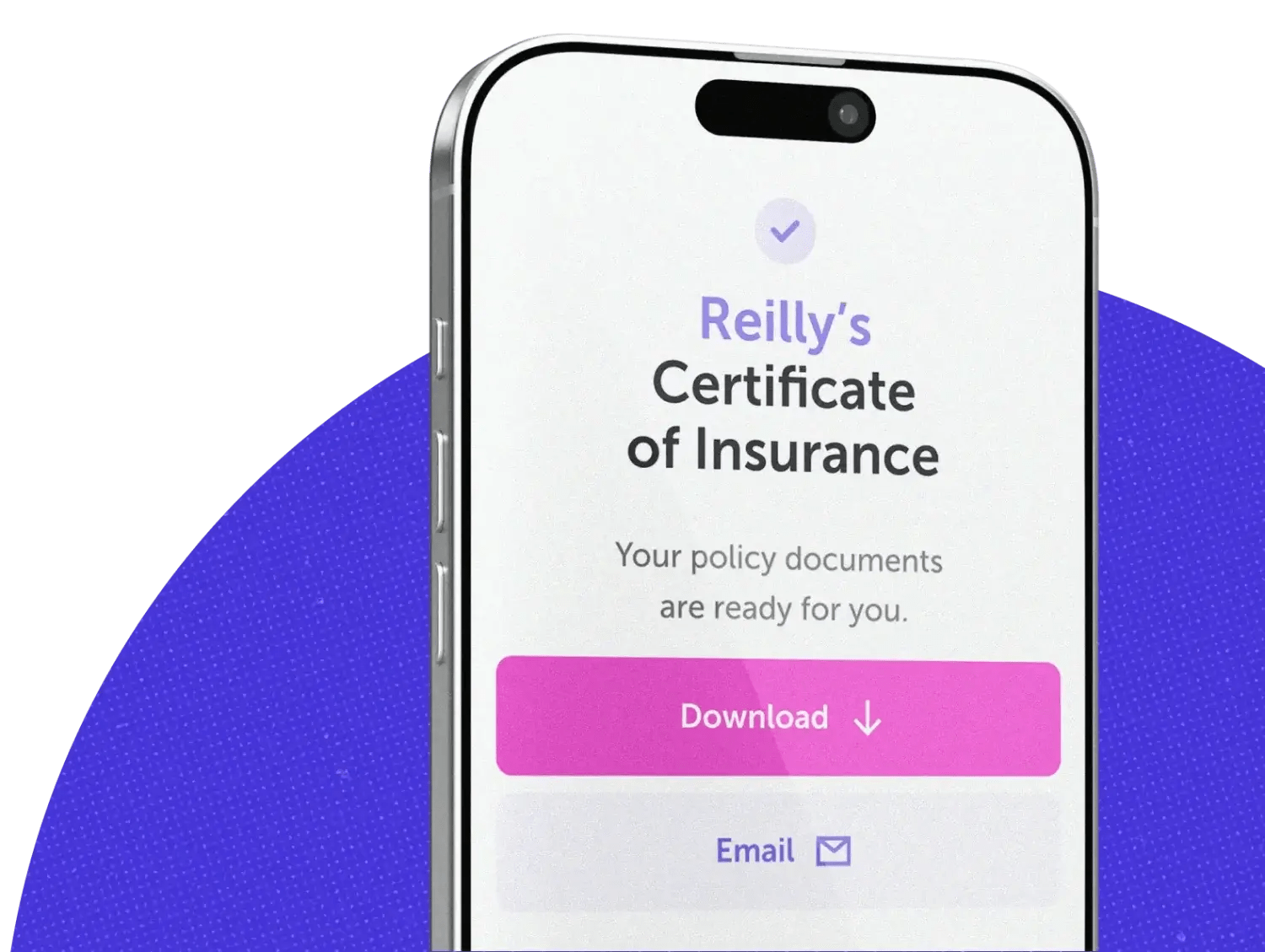
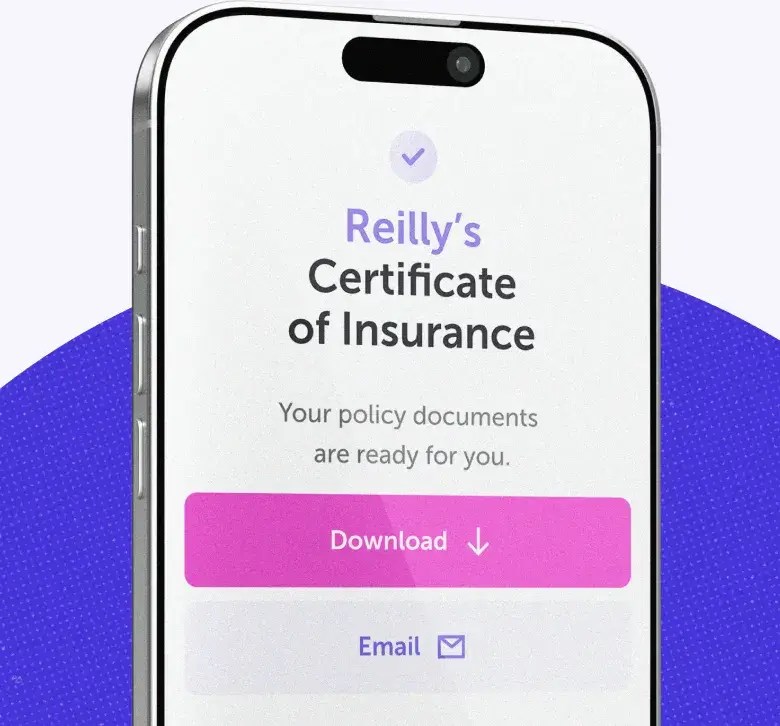

Simple management
Add certificate holders, additional insureds, and more.

Instant access
Get most COIs in minutes online in your account.
Simple management
Add certificate holders, additional insureds, and more.

Easy sharing
Download and send COIs on your mobile.

Written by
What Is a Certificate of Insurance (COI)?
A certificate of insurance, or “COI”, is usually a one-page document that proves your small business is protected by insurance. A COI isn’t the insurance policy itself — it’s a sharable summary. Think of it as a quick snapshot of your coverage, limits, and policy effective dates.
Sooner or later, a client will ask to see your COI before they’ll sign a contract or let you on the job. With Simply Business, you can download and share your COI quickly to keep the work moving.
Why do I need a COI?
A COI is what turns “I have insurance” into something a client, landlord, or lender can quickly verify. Without it, you’re asking them to take your word for it — and most won’t, especially when there’s a contract, a lease, or a loan on the line.
A current certificate of insurance can help your business:
Clients, landlords, lenders, and licensing boards often require proof of coverage before they’ll move forward with contracts and other opportunities to grow your business.
Sending over a clean, current certificate signals that you run a professional, well-prepared business, and reassures clients and landlords that they’re protected if something goes wrong.
Your COI distills a multi-page policy into a concise summary that’s ready to download whenever a client asks. No digging through documents required.
What Does a Certificate of Insurance Include?
A COI is a concise summary of your coverage. At a glance, it typically shows:
- Your business name and mailing address
- Your insurance company’s name and contact information
- The types of coverage you carry — for example, general liability, BOP, professional liability, workers’ comp, etc.
- Your coverage limits for each policy
- Policy effective and expiration dates
- Additional insureds listed on the policy — third parties granted coverage under your insurance.
Types of Certificates of Insurance
The type of COI you’ll need depends on the coverage a client, landlord, or contractor requires.
Most small businesses typically need proof of one or more of these:

General Liability
A general liability COI confirms you’re covered for third-party bodily injury and property damage. It’s the most common certificate clients, landlords, and contractors usually ask to see.

Business Owner’s Policy (BOP)
A COI for a BOP shows you carry a bundled policy that typically includes general liability, commercial property, and business interruption coverage. It’s the one to share when a landlord or vendor wants proof you’re covered for both liability claims and damage to your primary business property, though it typically won’t cover the business equipment and inventory you bring to off-site events like a craft show.

Professional Liability
A professional liability COI proves you carry coverage if a client sues you for professional mistakes, oversight, or negligence, for example. Customers hiring you for professional services or advice often want to see one before signing.

Workers’ Compensation
A workers’ comp COI confirms you carry coverage for employee injuries and illnesses tied to the job. Most states require it for businesses with employees, and some states require it for certain trades like construction even if you are a sole proprietor. General contractors often ask for proof before letting you bring a crew on site.
When Does My Business Need a COI?
A COI request tends to come up at predictable moments — usually right before someone agrees to hire, license, rent, or lend to you. Here are some of the most common triggers.
Many clients require proof of insurance before signing a contract, and on bigger jobs, your COI often needs to be in the bid package itself. A wedding photographer pitching a luxury venue, a freelance graphic designer landing a corporate retainer, an electrician bidding on a commercial build-out — you may be asked for a COI before the paperwork moves forward.
Certain professions require proof of insurance to apply for or maintain a license — real estate agents, general contractors, cosmetologists, and many trade specialists, depending on the state. While licensing boards likely require it to keep you legally compliant, having that coverage also signals to clients that you’re running a legitimate, protected business.
Commercial landlords almost always require proof of insurance before handing over the keys, and many will ask to be named as an additional insured on your policy and COI. A restaurant owner signing a lease on a new storefront, a yoga instructor renting studio space, a hair stylist leasing a chair at a salon — can generally expect to be asked for a current COI as part of your lease agreement.
Lenders want assurance that your business can weather a setback without potentially defaulting on the loan. Most banks and the Small Business Administration (SBA) require proof of insurance during the application process — usually general liability at a minimum, plus workers’ comp if you have employees. It’s always best to double check the specific requirements that apply to your business.
What Is an ACORD Certificate of Insurance?
ACORD is the nonprofit organization that designs the standardized COI forms used across the insurance industry. When someone refers to an “ACORD certificate” or an “ACORD 25,” they’re usually talking about the standard document most people call a COI.
The standardization matters because it means every certificate of insurance typically looks the same, no matter which carrier issued it. A client reviewing your COI knows exactly where to find your coverage types, limits, and effective dates, making verification easier.
The two ACORD forms small business owners encounter most:
This is the standard COI. When someone in business says “send me your COI,” they almost always mean an ACORD 25. It proves you have protection if your business operations cause bodily injury or property damage to a third party.
If you purchase a policy through Simply Business, your ACORD COI will be available to download from your online account.
If you purchase a policy through Simply Business, your ACORD COI will be available to download from your online account.
Certificate Holder vs. Additional Insured: What’s the Difference?
When a client asks to be listed on your COI, they’re often looking for one of two things: status as a certificate holder or an additional insured. They sound similar, but they do very different jobs, and confusing the two can leave a client unprotected and you potentially in breach of contract.
is simply the person or company receiving a copy of your COI. Their name on the certificate is proof to them that you have an active policy at that moment.. It’s informational, and it doesn’t extend any of your policy’s insurance coverage to them.
is a person or company added to your policy so they’re actually protected under your liability coverage for claims tied to your work. If a third party sues your client because of something that happened on your job, your client’s additional insured status means your policy can respond, if covered.
A quick breakdown:
- A certificate holder gets a COI.
- An additional insured gets a COI and coverage.
Certificate Holder | Additional Insured | |
|---|---|---|
| Receives a copy of the COI | Yes | Yes |
| Covered under your policy | No | Yes |
| Common request from | Most clients, landlords | General contractors, larger clients, venues |
| Cost to add | Usually free | May involve a small endorsement fee |
What Is a Waiver of Subrogation?
Subrogation sounds like a fancy irrigation contraption, but it’s actually a standard process.
When your insurance company pays out a claim for damages you suffered, it doesn’t always just absorb the cost. If someone else caused the loss, your insurer has the right to go after that third party to recover its money. That right is called subrogation. And a waiver of subrogation waives that right.
For example, say you’re a plumber working on a new build. Something goes wrong on the job, and your insurance pays out to settle the claim. Later, your insurer decides the general contractor (GC) was partly responsible and sues them to get its money back. That’s subrogation.
A waiver of subrogation, signed in advance and added as an endorsement to your policy blocks the insurer from recovery and protects the GC.
General contractors, landlords, and larger clients often require a waiver of subrogation before they’ll let you start work — and they’ll usually want to see it noted on your COI. A waiver gives them confidence that once a job is done, it’s done, with no potential surprise lawsuits from your insurer down the road.
A waiver of subrogation is an endorsement, meaning it gets added to your policy rather than coming standard. Your insurer can typically add it to a general liability, workers’ comp, or other policy, depending on what the contract requires. Some carriers include it at no charge; others charge a small fee per waiver.
If a contract requires a waiver of subrogation, the safest move is to share the contract language with your insurer so they can add the right endorsement to the right policy.
Common COI Mistakes to Avoid
A COI is only useful if it’s accurate, current, and matches what the contract requires. The mistakes below are easy to miss, and any one of them can hold up a deal at the worst possible moment.
- Letting your policy lapse: An expired COI is the same as no COI. Check your renewal date and request a fresh certificate as soon as your policy renews.
- Missing the additional insured: If your contract requires a client or GC to be named as an additional insured and they’re not on your certificate, the COI won’t satisfy the requirement — even if your underlying policy is solid.
- Coverage limits that fall short: Contracts often spell out minimum limits (for example, $1 million per occurrence in general liability). Make sure your policy actually meets the contract’s minimum before you send the COI over.
- Missing the waiver of subrogation: If a contract requires one and your COI doesn’t show it, the certificate won’t pass muster. Confirm with your insurer that the endorsement is on your policy and reflected on the certificate.
- Small errors on the form: A misspelled business name, the wrong address, an outdated DBA — these look like minor typos, but can render a COI invalid when a client tries to verify it. Review your certificate the moment you receive it.
How to Get Your COI with Simply Business
For most small businesses, getting a COI is a quick three-step process:

Check the requirements
Before you contact your insurer, look at what the contract or client actually requires — usually the types of coverage and the minimum limits. If anything’s unclear, ask the client to spell it out in writing.

Compare the requirements
Pull up your current policy and check that your coverage types and limits meet the requirements. If they fall short, talk to your insurer about raising your limits or adding an endorsement before requesting or updating the certificate.

Request your COI
Most insurers issue certificates through an online portal or by phone. With Simply Business, your COI is generally ready to download from your account whenever you need it — no waiting on a callback.
Manage your COI with Simply Business:
- Instantly download your COI
- Add a certificate holder, additional insured, and endorsements or special wording.
- Share a copy via email
- Store a copy in your digital wallet
Answers to More Questions About COIs
Your insurance policy is the full contract with your insurer — every coverage term, exclusion, and limit spelled out in detail. The COI is a concise summary proving the policy exists. The policy is what protects you; the certificate is what proves it.
No. A COI is proof of an active insurance policy — without coverage in place, there’s nothing to certify. You’ll need to purchase and maintain a policy before you can request a certificate.
A COI is valid as long as your policy is active. Once it expires or is cancelled, the certificate is no longer valid. When you renew, your insurer will issue a new COI reflecting the updated dates.
Not necessarily. The same COI can be shared with multiple clients as long as your coverage meets what each one requires. Some clients will ask for a customized certificate naming them as an additional insured or showing specific endorsements, and your insurer can issue one when needed.
A COI is typically included with your policy at no extra charge. Some insurers charge a small fee for additional copies or customizations, though some states may not allow fees for certificates of insurance. With Simply Business, your COI is included with your policy and ready to download from your account as soon as your policy is active.
The certificate becomes outdated as soon as the underlying details change — a new business address, an updated DBA, a coverage adjustment. Update your information with your insurer, then issue a fresh certificate to any clients or partners relying on the old one.
Talk to your insurer about closing the gap — you may need to raise your limits or add an endorsement like an additional insured or waiver of subrogation, if available. Once your policy reflects the new coverage, your insurer can issue an updated certificate that satisfies the contract.

Written by
Our +1 million customers are big fans. And you will be too.

I went online, looked around, and found Simply Business. The process was so seamless. I got my certificate within minutes. It was just phenomenal.

Karen
Owner of Tangaza Bath & Body Studio LLC
With Simply Business I know I can look at different carriers, but also see all my stuff in the same place… a lot of [insurance] providers don’t offer a variety of coverage, all in one place.

Jef
Owner of Bunker83 LLC
It wasn’t overwhelming to figure out what was covered and what wasn’t covered. And the cost was competitive.

Kim
Owner of Room to Breathe Professional Organizing
Page last updated: