When is General Liability Insurance Required?

Small Business information you can trust.
Updated August 2025 by Ed Grasso
Insuring over 1 million small business owners worldwide.


Buy instantly online. No junk mail. No spam calls.
Insuring over 1 million small businesses worldwide.
Buy instantly online. No junk mail. No spam calls.
Is General Liability Coverage a Legal Requirement?
In the U.S., business insurance legal requirements vary by state and type of business, so it’s worth checking to see what your particular state requires. Even if general liability insurance isn’t a requirement in your state, it’s a good idea to have insurance coverage to help protect your personal finances in case of accidents, injuries, and other potential risks. You may also be required to have general liability coverage for your contracts or even your commercial lease.
When is General Liability Insurance a Good Idea?
How Much General Liability Insurance Do I Need?
This depends on a number of factors. On one hand, you may need more general liability coverage if you’re working on a big project and a customer requests a higher policy limit. On the other hand, you may only need a basic amount of coverage if you don’t do too much work on customer sites.
Coverage is generally described in two ways: “per occurrence limit” and “aggregate limit.”
Per occurrence limit – This refers to the maximum amount an insurance company will pay for a single covered incident. For example, let’s say your general liability policy has a $1 million per-occurrence limit. If there’s a work-related accident where a customer or client gets hurt and it results in a $600,000 claim, the insurance company would pay up to $600,000. If the damages were $1.1 million, the policy would pay $1 million, and your business would be responsible for the remaining $100,000.
Aggregate limit – This is the total amount an insurer will pay out for all covered claims during the policy period, usually one year. If you have a $1 million aggregate limit and you’ve already had a claim for $600,000 (as in the example above), then your insurer will only cover another $400,000 in claims during the same policy period.
Other considerations when determining your coverage amounts.
1. Your company size.
The more employees and subcontractors you have, the more liability insurance you may need.
2. The type of work you do.
If you perform work that exposes you to a lot of risks (like tree removal or roof work), it’s recommended you get a higher policy limit. That’s because if you end up causing third-party injuries or damage, the claim payout will probably be higher.
3. Your state’s requirements.
Many states have general liability insurance requirements; these can vary depending on the type of work you do and where you’re located.
4. The project you’re working on.
As previously mentioned, you may need more general liability coverage if you’re working on a pricey project or if you’re performing work as a government contractor.
If you’re still not sure how much general liability insurance you’ll need, don’t worry – a licensed agent at Simply Business can answer all of your questions. You can speak with one at (855) 869-5183, M-F 8am-8pm ET.
A Look at General Liability Cost
Here’s a snapshot of what our customers typically pay for general liability insurance:
Monthly General Liability Insurance Costs1
Under $25
18% of customers
$25 to $95
67% of customers
Over $95
15% of customers
1Data from Simply Business customers who purchased a GL policy from July 1, 2024 to December 31, 2024.31, 2024.
What you pay depends on a few key things, including: your industry, location, number of employees, and how much coverage you choose. But most small businesses will pay $95 or less per month.
These numbers are based on real policies purchased through our site. But getting a great premium isn’t just about the numbers — it’s about working with a partner who understands your business. And because we work with a range of trusted insurers, you’ll see options to match your business, so you can choose a policy that works for you and your budget.
Below are examples of the median cost of general liability insurance across different states:
State
Median Monthly Cost2
New Jersey
$78
Florida
$60
South Carolina
$52
Colorado
$51
Georgia
$50
Texas
$49
New York
$42
North Carolina
$42
Pennsylvania
$42
California
$38
2Data from Simply Business customers who purchased a GL policy from July 1, 2024 to December 31, 2024 in the identified states.
Number of employees
Mistakes happen. And the more employees you have, the more chances there are for something to go wrong. That’s why insurers may ask how many people work for you when calculating your premium.
Policy limits
Higher coverage usually means a higher premium. But it also means more protection if something goes wrong. Most small businesses go with a $1 million or $2 million policy. It’s solid protection for many types of lawsuits or accidents without overdoing it. In fact, 97% of our customers choose the $1 million level of coverage.
What else can affect the price?
- Your claims history. If you’ve had past claims, that might bump up your rate.
- Your experience. Have you been in business for years with no claims? That could work in your favor.
Who Needs General Liability Insurance?
Sole proprietors, partnerships, LLCs, and more. General liability is a coverage we recommend for just about any business.
What Does General Liability Cover?
General liability (GL) can help cover the costs of claims, medical bills, legal expenses, and more – which can run into tens of thousands of dollars.
If you find yourself interacting with clients in any way, we typically recommend getting a general liability insurance policy. This business insurance can also typically help cover your employee or employees if they cause damage.

Third-party property damage
General liability policies can help cover expenses if you accidentally break, damage, or destroy a client’s personal property.

Third-party injuries
If a customer is injured at your office or work site, a general liability insurance policy can help cover their medical expenses.

Advertising injury
A GL policy can help cover claims and legal expenses if you’re sued because of your business’ advertising, marketing, or social media activities.

Faulty products
If you sell a faulty product that causes bodily harm or damage to a customer’s property, a general liability can help cover claims and legal costs.
What Information is Needed to Apply for General Liability Insurance?
Getting general liability insurance doesn’t have to be complicated or time-consuming. Here is the basic information you’ll need. You can learn more about applying for general liability coverage here, but here is the basic information you’ll need:
- Basic business information
- Details about what you do and your business operations
- Your insurance and claims history
- Your coverage requirements
The Simply Business Difference
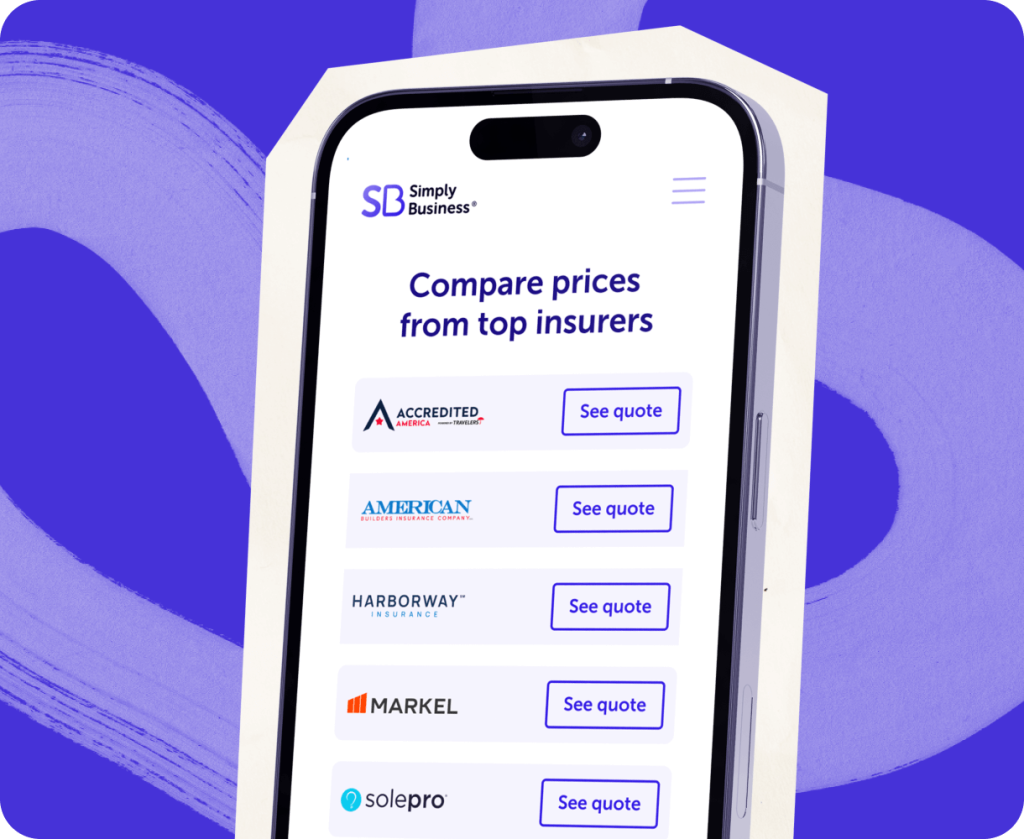
We make small business insurance simple — so you can get covered without the hassle. We’re a digital insurance brokerage. That means we’re not tied to one insurer. Instead, we partner with a range of top-rated carriers. With one easy form, you can compare quotes from top-rated insurers and choose coverage that fits your business, your risks, and your budget.
No hidden costs. No guesswork. Just clear, affordable options built for small business owners like you — so you can move forward with confidence, knowing you’re not overpaying.
Small business insurance made simple.

Search
Answer a few questions and get coverage recommendations for your business.

Compare
View custom quotes from top-rated small business insurers.

Save
Choose your policy, many with up to 20% savings.*
Feel confident in your choice.
We partner with a range of top-rated carriers and use smart technology to match you with policies that fit your specific business, your risks, and budget.

400+
business types covered

1M+
customers worldwide

18
top-rated carriers



We’ve Got More Helpful Information
6-minute read
What is Liability Insurance?

9-minute read
A General Liability Insurance Guide for Small Business

8-minute read