Small Business Insurance in Massachusetts

Get a price estimate in just three steps
Rates as low as $20.75/month*
Get a price estimate in just three steps
Rates as low as $20.75/month*
Over 1 million customers worldwide.


Buy instantly online.
Massachusetts Small Business Insurance
Massachusetts is home to a wide variety of businesses, from life science firms in Cambridge to seasonal shops on the Cape, and contractors and restaurants from Berkshire to Boston. Each poses its own risks, and having the right business insurance in Massachusetts can help cover the financial fallout if something goes wrong.
Massachusetts small business insurance requirements depend on your industry, how many people are on your payroll, and what your clients or landlords have in a contract, plus a number of other factors. The coverage a solo financial advisor in Boston needs doesn’t look like what a framing crew on a South Shore job site carries, and what you will need for coverage also changes as you hire staff or take on bigger clients.
Sorting out which policies apply to your business makes it easier to compare your options and get covered.
Is Business Insurance Required in Massachusetts?
Two coverages are mandatory under Massachusetts law. Employers must carry workers’ compensation insurance, and any vehicle, including company vehicles, must carry automobile insurance to be registered in the state.
Massachusetts doesn’t require general liability (GL) or professional liability insurance for most businesses. However, in practice both may be regularly required—and often advisable—for businesses operating across many industries. For example, clients often require proof of general liability or professional liability coverage before signing a contract, and commercial landlords typically require GL coverage before approving a lease.
What Types of Small Business Insurance Are Required in Massachusetts?
A Massachusetts business usually needs several of these coverages, each with its own rules and reasons to have it.
Workers’ Compensation Insurance in Massachusetts
In Massachusetts, workers’ comp coverage is required once a business takes on an employee. There’s no minimum headcount, and part-time, seasonal, and temporary staff all count as employees. The only exception is for domestic employees, who must work at least 16 hours a week to be covered.
Workers’ compensation insurance typically helps pay for an employee’s medical treatment and replaces some of the wages they lose while recovering from work-related injury or illness that requires coverage.
Sole proprietors and partners without employees aren’t required to carry workers’ comp, though they can choose to buy it for themselves. Corporate officers are covered as employees by default, but those who own at least 25% of the company can apply for an exemption.
Professional Liability Insurance (E&O) in Massachusetts
Errors and omissions (E&O) coverage, or professional liability insurance as it’s also known, steps in when a client blames your professional work for their financial loss. The coverage is meant to handle legal defense costs and any settlement within your policy limits, even if the claim is ultimately determined to have no merit.
While Massachusetts requires professional liability insurance (often called malpractice insurance) for certain licensed medical professionals, it leaves the coverage optional for most other businesses. However, for many consultants, financial firms, and tech companies in the state, it’s seen as an essential coverage for dealing with clients because many contracts won’t move forward without it.
General Liability Insurance in Massachusetts
General liability insurance typically covers third-party claims, such as a customer injured on your premises, property you damage on a job, or an advertising injury like libel. Depending on your policy, coverage may also extend to related medical bills, repair costs, and legal fees.
General liability is not mandated in Massachusetts for most businesses. However, cities and towns may require proof of coverage for contractor and trade licenses to both get and keep a license. In Boston, for example, construction permits require proof of liability insurance from contractors before a building permit is issued.
Beyond licensing, commercial leases in Massachusetts often require tenants to carry general liability coverage.
Commercial Auto Insurance in Massachusetts
Auto coverage is required for every vehicle registered in the Commonwealth of Massachusetts. Massachusetts is a no-fault state, so every auto policy has to include Personal Injury Protection (PIP) of $8,000 per person, which covers medical costs and part of your lost wages resulting from an accident, regardless of fault. The state’s minimum limits are $25,000 per person and $50,000 per accident for bodily injury, $25,000 per person and $50,000 per accident for uninsured motorist coverage, and $30,000 for property damage.
Business-owned vehicles must meet these limits as well. A standard personal policy typically won’t cover a vehicle that’s mainly used for business, which can leave your work car or truck without protection. Business auto insurance in Massachusetts covers anything from a single delivery truck to a small fleet.
Simply Business doesn’t currently offer commercial auto insurance, but our licensed insurance agents can help you find providers that do.
How Much Does Business Insurance Cost in Massachusetts?
What a Massachusetts business pays for coverage depends on a variety of factors, from payroll to past claims and more.
Here are the median monthly cost ranges for common policies, based on what Simply Business customers in Massachusetts pay*:
Median Monthly Costs1
| General liability | $43 |
| Workers’ compensation | $113 |
| Professional liability | $42 |
*Data from Simply Business customers located in Massachusetts, who purchased at least one or a combination of general liability, professional liability, and workers’ compensation policies from July 1, 2025 to December 31, 2025. The median costs shown are for illustrative purposes only; actual premiums vary by state, coverage limits, and individual business risk.
Some factors that may change premium costs include:
- Payroll: The more you pay in wages, the more your workers’ comp tends to cost, since premiums track payroll and staff size.
- Industry risk: A roofing or framing contractor carries more risk than an accounting firm, and premiums typically track that difference.
- Location: A storefront in a busy Boston neighborhood carries different theft and liability exposure than one in a quieter suburban or rural area, and premiums reflect the difference in risk.
- Claims history: Past claims can make you appear riskier to an insurer, which often shows up as a higher rate.
State-Specific Risks for Businesses in Massachusetts
Massachusetts business owners face a particular set of risks unique to the state, from winter storms and coastal flooding to strict data-security rules.

Nor’easters and Winter Storm Risk
Nor’easters hit Massachusetts from October through May and can cause similar damage as a hurricane, with significant snow or heavy rainfall and strong winds. For example, a roof may collapse under heavy snow, or an icy sidewalk could turn into a slip-and-fall claim. Commercial property coverage helps pay for the damage. Because a bad storm can shut a business for days, many Massachusetts businesses add business interruption insurance to cover lost income during a closure.

Coastal Flooding and Storm Surge
Massachusetts has a long coastline, and storm surges from nor’easters and Atlantic storms put businesses along Boston Harbor, Cape Cod, and the North and South Shores at flood risk. Standard commercial property insurance and business owner policies (BOP) often exclude flood damage, so coastal businesses usually carry a separate policy through the National Flood Insurance Program or a private insurer.

Data Security and the WISP Requirement
The Commonwealth has strict data-security obligations that apply to almost any business that handles personal information about a resident. Under Massachusetts law, you must maintain a written information security program (WISP). If a breach occurs, businesses must notify affected residents as soon as practicable and report it to the Attorney General and the Office of Consumer Affairs and Business Regulation. If Social Security numbers are exposed, you also must provide those affected with 18 months of free credit monitoring.
Cyber liability insurance can help cover the costs of notification, monitoring, and legal services stemming from a breach.

Life Sciences and Biotech Product Liability
Boston and the Kendall Square area of Cambridge are home to some of the world’s most well-known life sciences and biotech companies. Startups, contract research organizations, staffing firms, and equipment suppliers in this industry may face higher product liability and professional liability claims, so they often carry more coverage than a typical small business.

Who Needs Massachusetts Small Business Insurance?
Best Massachusetts Business Insurance for Your Industry
Industries often determine which policies a Massachusetts business needs most.
Construction Insurance in Massachusetts
Construction in Boston is booming, and it carries more liability risk than most kinds of work. Large commercial contracts often require that subcontractors carry general liability coverage, and the required limits usually come from the project contract, so larger commercial jobs tend to have higher per-occurrence limits than smaller ones. In Massachusetts, workers’ compensation is required once you hire your first employee, and it helps cover on-the-job injuries.
Professional Services in Massachusetts
Massachusetts has large financial services, consulting, and healthcare advisory sectors, so professional liability insurance is often a near-universal need for most businesses in these industries. These firms are paid for their advice, so a mistake or missed detail can become an expensive client claim.
Firms that store client information may also carry cyber liability coverage, because the state can pursue data-security failures under its consumer protection laws.
How to get a Certificate of Insurance in Massachusetts
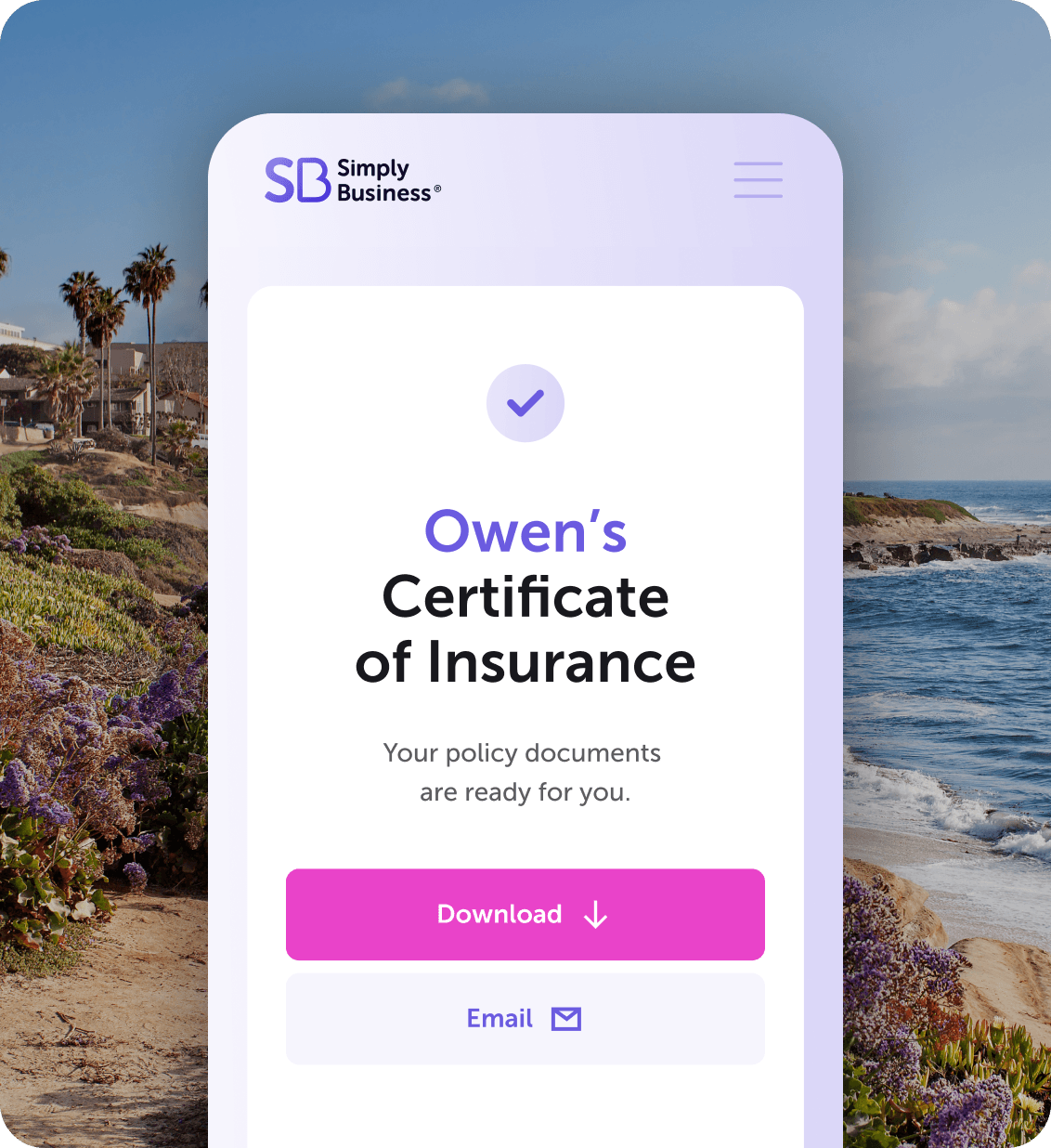
A certificate of insurance (COI) is a document that shows your business has active coverage, along with the policy type(s), limits, and your insurer(s). Massachusetts clients, landlords, and licensing boards commonly ask for one before you take on a project, move into a leased space, or renew a license.
With an active Simply Business policy, you can pull your COI from your account, list clients as additional insureds, and download it whenever you need it.
FAQs About Massachusetts Business Insurance
Yes, in Massachusetts workers’ compensation is required as soon as you hire one employee, and there is no minimum number of workers.
A WISP is a Written Information Security Program. Massachusetts requires one for any business that handles residents’ personal data.
As of July 1, 2025, the state minimums for auto insurance coverage remain $25,000 per person and $50,000 per accident for bodily injury and $30,000 for property damage. Drivers are also required to have Personal Injury Protection, which covers medical expenses, some lost wages, and replacement services up to a limit of $8,000.
Our Massachusetts customers are big fans. And you will be too.
Very easy to obtain with lots of options to add as far as what your business needs. The pricing was also better than all could offer.
Darrell I.
General Contractor
Easy questionnaire, easy to see and choose the coverage and company to cover my company.
John D.
Handyperson
Process was easy; rates are reasonable; advice was invaluable.
Janice S.
Business Consulting
Additional Information and State Resources for Massachusetts Small Business Owners
Mass.gov – Starting a Business in Massachusetts
Mass.gov – Business Front Door
EOED – Programs & Grants for Business and Innovation
Massachusetts Small Business Development Center (MSBDC)
Small Business Massachusetts

Written by
*The displayed price for each product is a monthly estimate calculated from the 10th percentile of relevant policies sold by Simply Business (e.g., General Liability data is used for General Liability estimates). This estimate uses data from relevant policy sales between July–December 2025. Final price and payment terms, which may include an initial down payment, are subject to change based on your state, selected insurance provider, and specific business details.
‡ Displayed price is based on the lowest available coverage limit for Equipment and Small Tools policies.
Page last updated: