Small Business Insurance in Oregon

Get a price estimate in just three steps
Rates as low as $20.75/month*
Get a price estimate in just three steps
Rates as low as $20.75/month*

Over 1 million customers worldwide.


Buy instantly online.

Written by
Small Business Insurance in Oregon
Oregon’s small business economy ranges from construction and outdoor recreation to farms and consulting. Each carries different risks, so Oregon business insurance requirements and the types of business insurance owners choose depends on the work a business does, if it has employees, where it operates, what clients or landlords require, and more.
But whether you’re a landscaping company in Bend or a consultant in Eugene, having Oregon commercial insurance can help cover the costs of an accident, injury, or a client claim. Here’s what small business insurance in Oregon covers, what it tends to cost, and which policies fit common industries across the state.
On this page
Find the information you need quickly
Is Business Insurance Required in Oregon?
Oregon law requires most employers with employees to carry workers’ compensation insurance. The state also requires that any motor vehicle be insured before it’s driven on public roads, which includes vehicles used for business purposes.
General liability, professional liability, and commercial property insurance aren’t required by state law for most Oregon businesses. But many clients request proof of general liability coverage before signing a contract. In addition, many commercial landlords and lenders may ask for it before approving a lease or financing.
Some licensed trades and professionals in the state are often required to carry specific insurance coverage to get and keep a state license.
What Types of Small Business Insurance Are Required in Oregon?
The coverage your business needs often depends on your industry, employees, and the vehicles and property it relies on. Many Oregon businesses bundle general liability (GL) and commercial property into a business owner’s policy (BOP), then add the specific coverage their trade or employees require.
Workers’ compensation insurance in Oregon
Almost any Oregon business with one or more employees, including full-time or part-time, must carry workers’ compensation coverage. Workers’ comp covers medical expenses, lost wages, rehabilitation costs, and death benefits for employees who are injured or become ill on the job. Premiums depend on your industry and total payroll.
Oregon has strict rules about who counts as a worker. As soon as you pay an employee, they are treated as a worker unless they qualify as an independent contractor. The state has a three-pronged criteria to determine if a worker is an independent contractor:
- If they are doing work that requires a license, like construction or landscaping, they must have the proper licensing on their own.
- The person controls how the job is done, decides what the work involves, and operates free from your direction.
- They have an independently established business.
General liability insurance in Oregon
General liability insurance covers third-party claims for bodily injury, property damage, and the legal costs that follow. Oregon doesn’t require it of most businesses, though some clients and landlords may require it.
In Oregon, every contractor licensed by the Construction Contractors Board must have general liability coverage to get and maintain a license. Coverage requirements vary; for example, a home inspection contractor needs $100,000 per occurrence, while a residential general contractor needs a minimum of $500,000 per occurrence, and a commercial general contractor needs a minimum of $1,000,000 aggregate.
The state maintains a list of the types of contractors who need to be licensed and carry specific insurance in Oregon. Here’s a few examples of the types of insurance you might need.
Professional liability insurance in Oregon
Professional liability insurance is also called errors and omissions (E&O) coverage. It helps cover legal costs and settlements when a client claims your professional advice or services caused them financial harm. It’s common for consultants, accountants, real estate agents, designers, and other business professionals who are paid for their expertise and services.
Oregon doesn’t require E&O coverage across the board, but some professionals may need it to perform their jobs. For example, active attorneys in private practice in Oregon must carry malpractice coverage through the Oregon State Bar Professional Liability Fund (PLF), a requirement that’s unique to the state.
Commercial auto insurance in Oregon
Any vehicle used for business in Oregon must meet the state’s minimum auto insurance limits: $25,000 for bodily injury per person, $50,000 per accident, and $20,000 for property damage. The state also requires uninsured motorist coverage of $25,000 per person and $50,000 per accident, as well as $15,000 in personal injury protection.
Most personal auto policies exclude business use, so an accident on the clock can leave you covering the damage. Commercial auto insurance will help cover deliveries, drives to job sites, and whatever else you use your vehicle for in your business.
Simply Business doesn’t currently offer commercial auto insurance, but our licensed insurance agents can help you find providers that do.
Unemployment insurance tax in Oregon
Unemployment insurance in Oregon is a state payroll tax, not a policy you buy from a carrier. Any business with employees has to register with the state and pay unemployment insurance tax, which funds benefits for workers who lose their jobs through no fault of their own. The amount is reported and paid annually based on your payroll and employer history.
Get free Oregon business insurance quotes in 10 minutes or less.
Simply Business provides customized coverage options from top-rated small business insurers — all in just 10 minutes. We do all the leg work so you can sit back, compare quotes, and save.
How Much Does Business Insurance Cost in Oregon?
Here are the median monthly cost ranges1 for common policies, based on what Simply Business customers in Oregon actually pay:
Median Monthly Costs1
| General liability | $41 |
| Professional liability | $42 |
| Workers’ compensation | $101 |
| Business owner’s policy | $48 |
1Data from Simply Business customers located in OR who purchased at least one or a combination of general liability, business owner’s policy, professional liability, or workers’ compensation policies from July 1, 2025 to December 31, 2025.
Business insurance costs in Oregon vary from one company to the next, and are determined by a few key factors. A few things determine how much your premiums cost:
- Payroll: Workers’ comp premiums climb with your headcount and total payroll, so a growing company often means needing to pay more to protect more.
- Industry risk: Higher-risk trades typically cost more to insure. A logging crew carries more exposure than a retail shop, and premiums track that gap.
- Location: Where a business operates may impact risk. A storefront in Portland has different theft and liability exposure than one in a rural area. Premiums may reflect that.
- Claims history: A record of past claims may signal more risk to insurers, which can push your rate higher.

Who Needs Oregon Small Business Insurance?
State-Specific Risks for Businesses in Oregon
Oregon businesses face a distinct mix of physical hazards and legal exposures, and the right coverage can help soften the financial hit if one lands.

Wildfires and Smoke
Oregon has a history of wildfire damage. Wildfire and smoke can damage property, interrupt operations, and force closures well beyond the burn area. Standard commercial property insurance usually covers fire damage, though businesses in high-risk areas may face higher premiums or want to confirm that wildfire and business interruption coverage are included.

Construction Defect Laws
Oregon construction businesses carry liability after a project wraps. The state has a 10 year statute of repose, which gives property owners up to a decade after substantial completion to bring a claim over a defect. Completed operations coverage can help protect your business during this window. It’s protection for claims tied to finished work, so a defect that appears years later can still fall within a policy’s protection rather than on the contractor directly.

Seismic Risk
Much of western Oregon lies within the Cascadia Subduction Zone, where a major earthquake poses a significant long-term threat. Standard commercial property policies often exclude earthquake damage, so coverage usually comes through a separate endorsement or a standalone earthquake policy. Businesses in this area may want to check whether their commercial property coverage includes it.
Best Oregon Business Insurance for Your Industry
Coverage may need to look different across industries, and a particular mix of policies may be right for your small business.
Construction and skilled trades insurance in Oregon
Before taking on work in Oregon, contractors must register with the Construction Contractors Board, which requires proof of general liability coverage in the required amount and a surety bond to issue and renew a license. For example, a residential general contractor needs a $20,000 bond, while a residential locksmith needs a $15,000 bond.
Many contractors and skilled trades workers consider inland marine insurance. Standard general liability policies won’t cover tools and equipment that are stolen or damaged on the job. But inland marine coverage, also known as tools and equipment insurance, can help cover these costs.
Outdoor adventure and tourism insurance in Oregon
Oregon’s outdoor recreation industry adds nearly $9 billion to the state’s economy each year, from river rafting and guiding fishing to ski operations and adventure tours. That work can carry real physical risk, both for the guides and the customers they take out.
Businesses in this space often need higher liability limits than a standard policy offers, along with coverage built around participant injury. Standard general liability often excludes the activities these operators offer, so specialty or excess coverage can fill the difference.
Professional services insurance in Oregon
Portland is home to many of the area’s professional consultancies, creative agencies, financial and tech firms. For these businesses, professional liability insurance helps cover claims that their advice or work caused financial harm.
Cyber coverage is another consideration for firms that handle client data. A data breach or ransomware attack can cost a small business over $100,000 in investigation fees, fines, and reputational damage. Cyber liability insurance costs around $145 per month for a typical small business policy with a $1 million limit.
How to get a Certificate of Insurance in Oregon
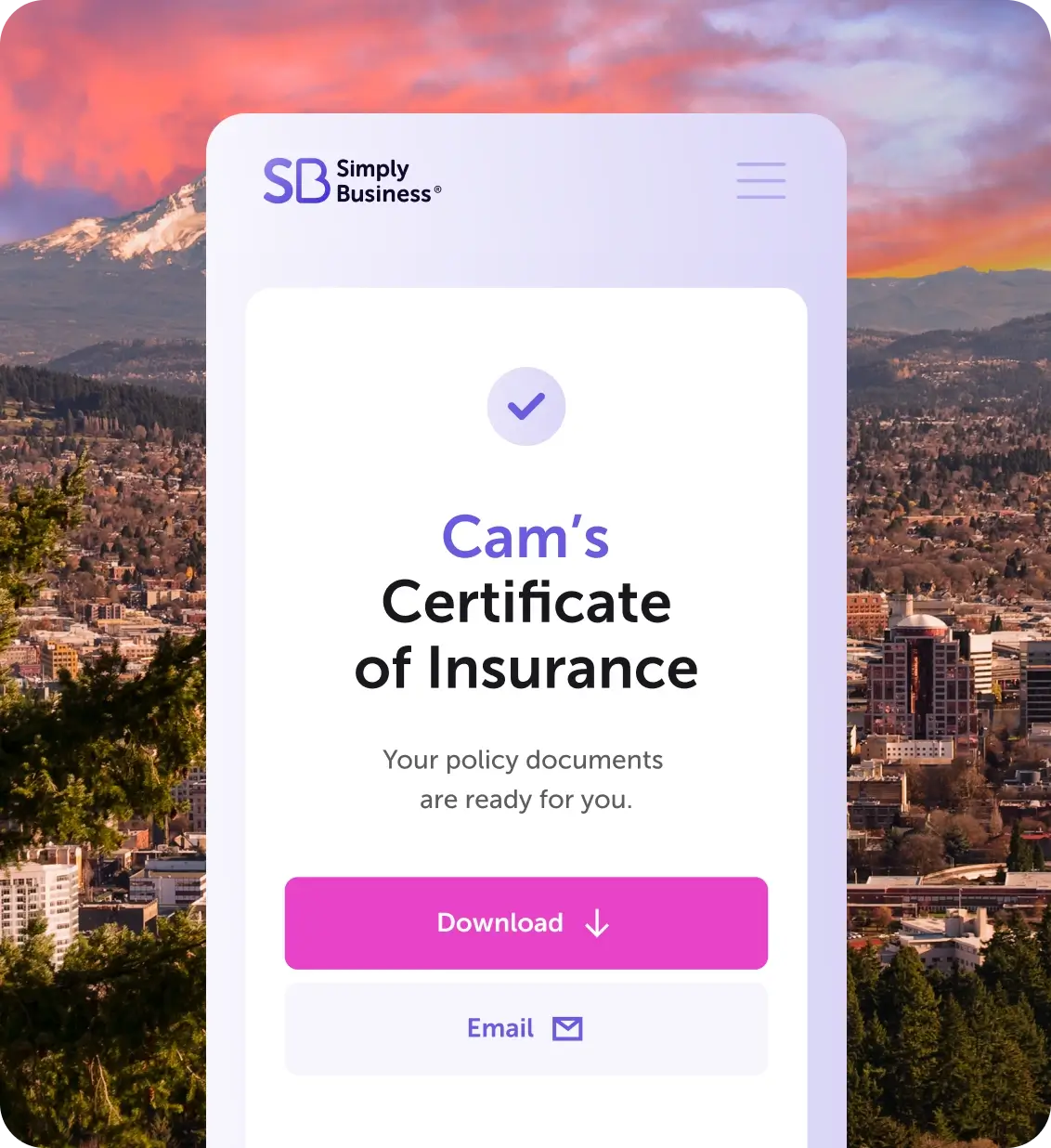
A certificate of insurance (COI) is a document that proves your business carries coverage. In Oregon, clients, commercial landlords, and licensing boards may ask for one before you can start a project, sign a lease, or get licensed.
Once you have an active policy through Simply Business, you can download your COI through your online account and add additional insureds to your certificate.
FAQs About Oregon Business Insurance
Is workers’ compensation required in Oregon for one employee?
Yes, almost any Oregon employer with one or more employees must carry workers’ compensation coverage, including part-time workers. Workers who qualify as independent contractors are the main exception.
Does a sole proprietor need workers’ comp in Oregon?
Usually, a sole proprietor with no employees isn’t required to carry workers’ comp for themselves, though they can select coverage if they want protection from on-the-job injuries. The same option applies to partners and LLC members.
Who regulates insurance in Oregon?
Insurance in Oregon is overseen by the Department of Consumer and Business Services (DCBS) through its Division of Financial Regulation, which handles licensing, consumer complaints, and market regulation.
Do cannabis businesses in Oregon have special insurance requirements?
In Oregon, cannabis businesses generally must follow the same basic rules as other businesses regarding workers’ compensation insurance, and state guidance recommends additional coverages such as liability and property as part of typical insurance coverage. The Oregon Liquor and Cannabis Commission (OLCC) oversees these businesses.
Why Work With Simply Business
Small business insurance is what we do. Whether it’s covering you for accidents and mistakes, meeting workers’ comp requirements, or protecting your tools and equipment, we can help find the coverage you need for your carpenter business.
We provide customized coverage options and quotes from top-rated small business insurers — all in just 10 minutes. More than 1 million small business owners worldwide trust us with their insurance, and we consistently earn high customer ratings and reviews.
Our +1 million customers are big fans. And you will be too.

It was simple to sign up and the cost was good. I already recommended you.

Beverly C.
Home bakery business
The process was smooth and easy to complete. I was able to obtain business insurance quickly to meet my marketplace requirements. The online experience was clear and user-friendly.
Trung P.
E-commerce/online retailer
I appreciated how easy it was to compare coverage options and obtain insurance quickly. The process was efficient, affordable, and professional.
Ainsworth S.
Handyperson
Additional Information and State Resources for Oregon Small Business Owners
Small Business Development Center (SBDC): Oregon small business insurance
Oregon vehicle insurance requirements
Workers’ compensation overview: Oregon requirements
Oregon independent contractor requirements
Oregon construction contractor’s board
Written by
*The displayed price for each product is a monthly estimate calculated from the 10th percentile of relevant policies sold by Simply Business (e.g., General Liability data is used for General Liability estimates). This estimate uses data from relevant policy sales between July–December 2025. Final price and payment terms, which may include an initial down payment, are subject to change based on your state, selected insurance provider, and specific business details.