Small Business Insurance in Pennsylvania

Get a price estimate in just three steps
Rates as low as $20.75/month*
Get a price estimate in just three steps
Rates as low as $20.75/month*

Over 1 million customers worldwide.


Buy instantly online.

Written by
Pennsylvania Small Business Insurance
Pennsylvania is home to a wide range of small businesses, from professional services firms in Philadelphia and Pittsburgh to manufacturing and construction across the Commonwealth.
Business insurance requirements in Pennsylvania depend on a number of factors we’ll explore below. Getting the coverage you need can help protect your business and keep you in compliance with Pennsylvania’s requirements.
On this page
Find the information you need quickly
Is Business Insurance Required in Pennsylvania?
Pennsylvania mandates both workers’ compensation and commercial auto insurance at the state level, with strict enforcement. Specific requirements depend on your workforce, the vehicles your business operates, and your industry.
General liability (GL insurance) and professional liability aren’t mandated by the state for most businesses, but they’re common requirements for client contracts and commercial leases. Some professions, like lawyers and medical providers, may also need to comply with industry-specific coverage rules.
What Types of Small Business Insurance Are Required in Pennsylvania?
Pennsylvania’s insurance requirements depend on your industry, workforce, and how your business operates. Here’s what to know about each policy.
Workers’ Compensation Insurance in Pennsylvania
Workers’ compensation can help cover medical bills, rehabilitation, and time away from work if an employee is injured on the job. In Pennsylvania, the Workers’ Compensation Act requires nearly all employers with one or more employees to carry coverage.
This includes part-time and family members on payroll, with some limited exceptions, such as domestic workers. Certain agricultural workers are also exempt if they work fewer than 30 days or earn less than $1,200 per year from one employer. The PA Department of Labor and Industry sets the standards and governs which employers must carry workers’ comp coverage for its employees.
Pennsylvania small businesses have four different ways businesses can get coverage: through a digital insurance brokerage (like Simply Business, for example), from a private carrier, applying for self-insurance status, or acquiring insurance through the State Workers’ Insurance Fund (SWIF).
General Liability Insurance in Pennsylvania
General liability insurance helps protect your small business against third-party claims, such as property damage and bodily injury. While it’s not legally required by state law, GL insurance is commonly required for commercial leases and client contracts in Pennsylvania.
If your business hosts on-site customers, puts clients at risk of reputational harm, or could cause property damage, it’s a good sign you may need general liability insurance.
Professional Liability Insurance (E&O) in Pennsylvania
Professional liability insurance, also known as Errors and Omissions (E&O) coverage, protects you from claims of negligence, missed deadlines, errors, or omissions in the work you deliver. It can also help cover legal defense costs, settlements, and judgments if a client files a formal legal claim against you.
Pennsylvania doesn’t require PL coverage, but it has a specific disclosure requirement for attorneys. Lawyers in private practice must notify clients in writing if they don’t carry at least $100,000 per incident and $300,000 per year in coverage.
Medical professionals may also face mandatory malpractice requirements. The MCARE Act requires physicians, hospitals, and other healthcare providers to carry medical professional liability insurance in PA.
Outside of those categories, E&O insurance in Pennsylvania is typically driven by client contracts. Consultants, accountants, marketing agencies, and other advice-based businesses may be required to carry it as part of their hiring agreement.
Commercial Auto Insurance in Pennsylvania
If your business owns or operates vehicles, your personal auto policy typically won’t cover accidents that happen during business use. A separate Pennsylvania commercial insurance policy for these vehicles can make a difference if you’re driving to jobsites, making deliveries, or transporting equipment to clients.
Pennsylvania requires liability coverage for all registered vehicles, including business-owned ones. The state’s minimum liability limits are $15,000 per person for bodily injury, $30,000 per accident for bodily injury, and $5,000 for property damage. Pennsylvania is also a “no-fault” state for medical benefits, meaning that all auto policies, including commercial ones must carry a minimum of $5,000 in Medical Benefits.
As of the date of this article, Simply Business doesn’t offer commercial auto insurance in Pennsylvania, but our licensed insurance agents can help you find trusted providers that do.
Get free Pennsylvania business insurance quotes in 10 minutes or less.
Simply Business provides customized coverage options from top-rated small business insurers — all in just 10 minutes. We do all the leg work so you can sit back, compare quotes, and save.
How Much Does Business Insurance Cost in Pennsylvania?
Here are median monthly cost ranges1 for common small business insurance policies in Pennsylvania:
Median Monthly Costs1
| General liability | $41 |
| Workers’ compensation | $90 |
| Business owner’s policy | $48 |
| Professional liability | $33 |
1Data from Simply Business customers located in PA, who purchased at least one or a combination of BOP, general liability, professional liability, and workers’ compensation policies from July 1, 2025 to December 31, 2025. The median costs shown are for illustrative purposes only; actual premiums vary by state, coverage limits, and individual business risk.
The cost of business insurance in Pennsylvania depends on several factors, and pricing can vary from one business to the next.
Some factors that affect your premium include:
- Payroll: Workers’ comp premiums in Pennsylvania are tied to your payroll size and headcount, so businesses with larger teams typically pay more.
- Industry risk: A roofer in Erie has a different risk profile than an accountant in Harrisburg, and premiums typically reflect that.
- Location: Operating in a major metro area like Philadelphia can affect your premium compared to a smaller city or rural area.
- Claims history: A record of prior claims can push your rate up at renewal.
State-Specific Risks for Businesses in Pennsylvania
Pennsylvania businesses face risks shaped by the state’s geography, industrial history, and labor laws. The right coverage can help protect against them.

Flooding Risks
Proximity to major rivers, such as the Susquehanna and Delaware, can put many Pennsylvania businesses at elevated flood risk. Standard commercial property insurance typically doesn’t cover flood damage, so business owners in flood-prone areas may need a separate policy through the National Flood Insurance Program or a private insurer.

Manufacturing Liability
Pennsylvania has deep roots in manufacturing, and businesses in that sector often face higher exposure to product liability and workplace safety claims. General liability coverage alone may not be enough; manufacturers often need product liability endorsements to cover defects or injuries caused by the goods they produce.

Construction Workplace Misclassification Act
Pennsylvania’s Construction Workplace Misclassification Act is a law not seen in many other states. It requires even self-employed construction contractors to maintain workers’ compensation coverage if they don’t meet strict independent contractor criteria. Civil penalties can reach $1,000 for the first violation and $2,500 for each subsequent one.

Who Needs Pennsylvania Small Business Insurance?
Best Pennsylvania Business Insurance for Your Industry
Every industry has its own risk profile, and Pennsylvania’s requirements can affect the type and amount of coverage you need.
Construction & Contractors
Construction is one of the highest-risk industries, and Pennsylvania contractors face both liability exposure and strict state classification laws. The Construction Workplace Misclassification Act can trigger fines and stop-work orders for contractors who misclassify workers, and standard workers’ comp, general liability, and commercial auto coverage are all common requirements on Pennsylvania job sites.
Professional Services
There are many consultants, accountants, and other professional service firms across Pennsylvania, from Philly to Allentown and State College. Professional liability (E&O) insurance and cyber liability insurance in Pennsylvania can help protect against claims of negligence, missed deadlines, or errors in your work. For many client contracts, proof of E&O coverage is a condition of doing business.
Retail & Hospitality
Retail shops, restaurants, and hospitality businesses face daily risks from customer foot traffic, theft, and property damage. A business owner’s policy (BOP) bundles general liability with commercial property coverage, which can help protect against slip-and-fall claims and theft of inventory or equipment in a single package.
How to get a Certificate of Insurance in Pennsylvania
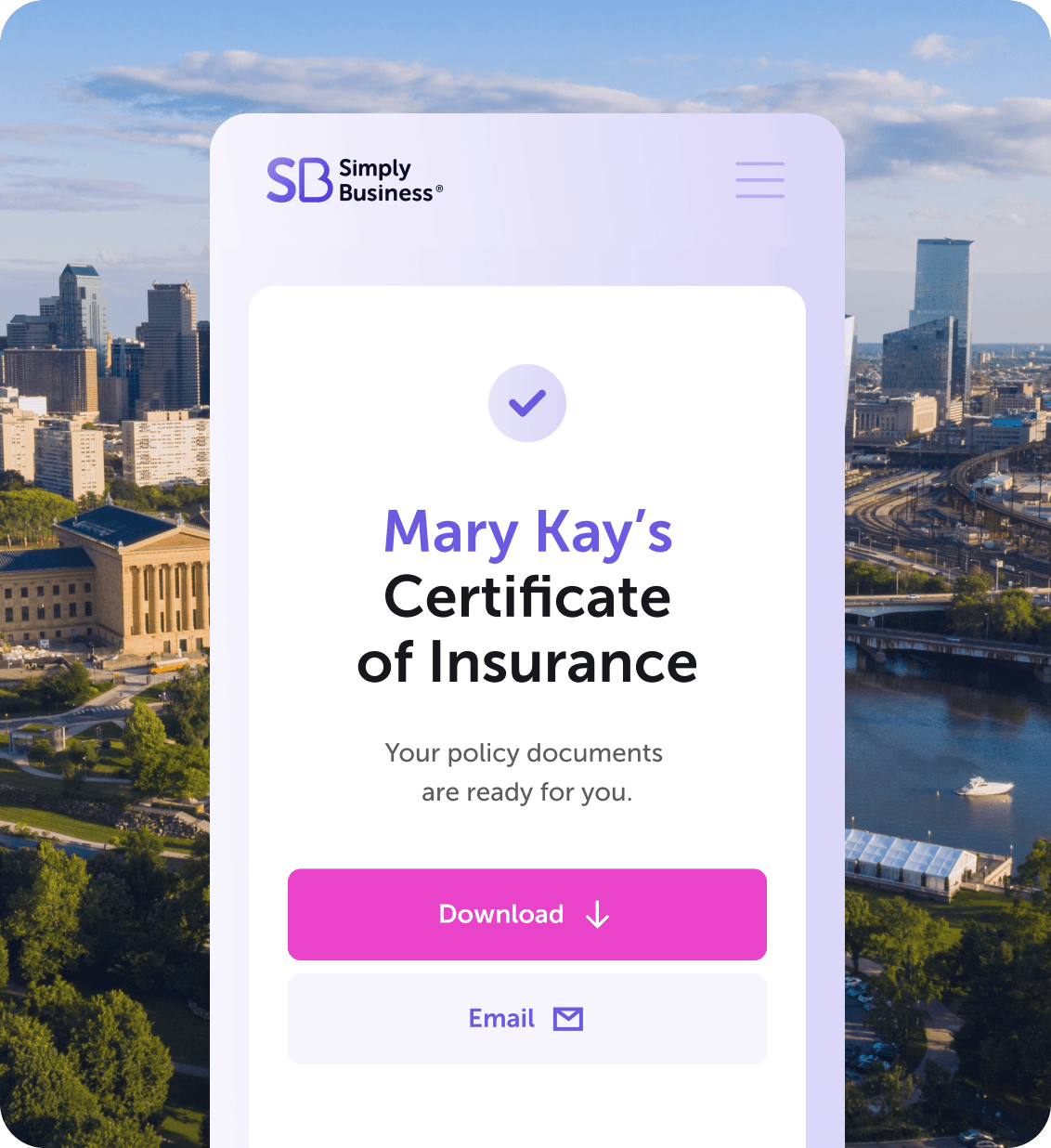
A Certificate of Insurance (COI) shows that your business has a valid policy in place and lists the coverage limits. Landlords, clients, and general contractors in Pennsylvania often ask for one before you can move forward with a lease, project, or subcontract.
Once your policy is active with Simply Business, you can generate a COI from your online customer account in a few minutes. You can also add additional insureds online whenever a new client or landlord requires it.
FAQs About Pennsylvania Business Insurance
Do I need workers’ comp for a part-time employee or family member in Pennsylvania?
Pennsylvania’s workers’ compensation requirement applies to virtually all employers with one or more employees. And family members on payroll count the same as any other worker.
There are some narrow exemptions from coverage. If you think your situation might qualify, check directly with the Pennsylvania Department of Labor and Industry.
What are the penalties in Pennsylvania for failing to carry workers’ compensation?
Failing to carry workers’ comp in Pennsylvania can carry serious consequences, including potential criminal actions against employers. A misdemeanor conviction can result in a fine of up to $2,500 per day, and up to one year in prison for each day of non-compliance. It’s also important to note that these fines can be assessed per day of non-compliance. Each day without coverage is a separate offense.
Intentional violations can result in felony charges, with the potential for fines up to $15,000 and up to 7 years in prison per day.
Is general liability required for an LLC in Pennsylvania?
Pennsylvania has no state law requiring LLCs to carry general liability insurance by state law. However, it’s a very common contractual requirement. Many commercial landlords, clients, and municipalities in Pennsylvania typically ask for proof of GL coverage before signing a lease or awarding a contract.
Our Pennsylvania customers are big fans. And you will be too.
It was fast, very easy to do and I didn’t have to wait for coverage.
Deborah D.
Housekeeping, PA
Very easy to make sure you have all the necessary coverage. Quick process, very user friendly!
Tanya A.
Painting & wall covering, PA
Having dealt with headaches of getting a COI, this was the easiest in 14 years.
Joe M.
Event planning, PA
Additional Information and State Resources for Pennsylvania Small Business Owners
Commonwealth of Pennsylvania: Business Insurance
Pennsylvania Workers’ Compensation Employer Information
Pennsylvania Department of Labor and Industry
Administration and Enforcement of the Construction Workplace Misclassification Act
Written by
*The displayed price for each product is a monthly estimate calculated from the 10th percentile of relevant policies sold by Simply Business (e.g., General Liability data is used for General Liability estimates). This estimate uses data from relevant policy sales between July–December 2025. Final price and payment terms, which may include an initial down payment, are subject to change based on your state, selected insurance provider, and specific business details.