Small Business Insurance in Arizona

Get a price estimate in just three steps
Rates as low as $20.75/month*
Get a price estimate in just three steps
Rates as low as $20.75/month*
Over 1 million customers worldwide.


Buy instantly online.

Written by
Arizona Small Business Insurance
Arizona is one of the fastest-growing states in the country, and small businesses are driving that momentum. From Phoenix tech startups and Tucson storefronts to Scottsdale restaurants, Sedona tour outfitters, and the construction crews framing new homes across the Valley of the Sun, local companies are thriving.
But building a business in the desert comes with its own rulebook. Triple-digit heat can knock out equipment, monsoon storms flood streets in minutes, and wildfires threaten the high country up north. Arizona also has one of the strictest workers’ comp mandates in the nation, requiring coverage the moment you hire your first employee.
This Arizona business insurance guide breaks down state requirements, what clients and landlords usually expect, and what coverage typically costs so you can get covered with confidence.
What Types of Small Business Insurance Are Required in Arizona?
Arizona’s insurance requirements depend on your industry, workforce, and how your business operates.
Here’s a breakdown of the coverages you’ll most likely need:
Workers’ compensation can help cover medical bills, rehabilitation, and time away from work if an employee is injured on the job.
Arizona sets one of the strictest bars in the country: If you have even one employee — full-time, part-time, or seasonal — you’re required to carry workers’ comp. There’s no small-business exemption and no minimum payroll to clear. The Industrial Commission of Arizona (ICA) enforces these rules under state law (A.R.S. Title 23), and it takes noncompliance seriously. Ignoring this mandate can trigger immediate stop-work orders and civil fines. Plus, your business will likely lose the legal protection that normally keeps employees from suing the business over a workplace injury, leaving the business potentially liable for all of the employees’ medical treatment, costs of recovery, lost wages.
Sole proprietors and partners with no employees are exempt, though they can choose to buy coverage for themselves. And if you hire subcontractors who don’t carry their own Workers’ Comp, you can end up being responsible for their claims, so it’s best to get a certificate of insurance proving coverage before anyone starts working.
General Liability insurance helps protect your small business against third-party claims, such as property damage and bodily injury. If a customer trips over a piece of equipment at your shop or you damage a client’s property, that’s exactly the type of third-party claim General Liability helps cover.
Arizona doesn’t require that businesses carry general liability insurance by law, and neither does the Arizona Registrar of Contractors (ROC) for statewide licensing — but in practice, you may not get far without it. Often general contractors, property owners, and clients won’t let you on a job or sign a contract until you show a Certificate of Insurance proving liability coverage, and many require limits of $1 million per occurrence and $2 million aggregate. Commercial landlords may also require proof before approving a lease.
A BOP typically bundles General Liability, Commercial Property protection, and Business Interruption coverage to help pay for third-party liability claims, property damage repairs, and lost income so you can get back to work quickly.
Arizona doesn’t require that businesses have a BOP, but for retail shops, restaurants, and other businesses with a physical location and equipment to protect, bundling property and liability coverage into one policy can be a cost-effective way to protect against everyday risks — from kitchen fires and theft to severe weather like monsoon dust storms and high winds.
One caveat worth knowing: A standard BOP typically won’t cover flood damage from rising water, and in monsoon season, Arizona sees exactly that type of flash flooding. Businesses in wash-prone or low-lying areas often add a separate commercial flood policy to close the gap.
Miscellaneous Professional Liability coverage, also known as Errors & Omissions (E&O) coverage, can help protect your business or your employees against claims of negligence, missed deadlines, errors, or omissions in the work you deliver. If a client files a lawsuit, it can help cover your legal defense, settlements, and judgments up to your policy limits.
Most Arizona businesses aren’t required to carry E&O, but some are. For example, licensed home inspectors must carry at least $100,000 per occurrence and $200,000 in aggregate E&O limits (or post a $25,000 bond) in order to maintain their state license. And if you’re paid for your advice — consultants, accountants, real estate agents, IT firms, and designers, just to name a few professions — this coverage can help provide a critical financial safety net, as a single claim can cost far more than years of premiums.
If your business owns or operates vehicles, your personal auto policy typically won’t cover accidents that happen during business use. A separate Arizona commercial auto policy covers that business driving — heading to jobsites, making deliveries, or hauling equipment to clients.
Any vehicle your business owns and registers in Arizona must carry liability coverage at the state’s minimum limits. You can confirm the current amounts with the Arizona Department of Transportation Motor Vehicle Division (ADOT MVD), which handles registration and insurance requirements.
As of the date of this article, Simply Business doesn’t offer commercial auto insurance in Arizona, but our licensed insurance agents can help you find trusted providers that do.
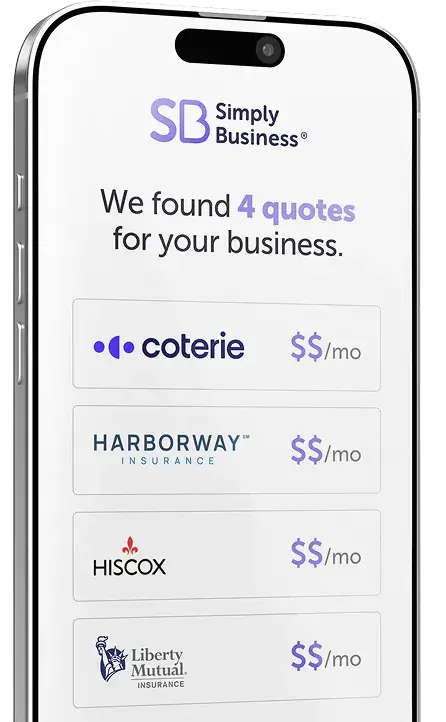
Get free Arizona business insurance quotes in 10 minutes or less.
Simply Business provides customized coverage options from top-rated small business insurers — all in just 10 minutes. We do all the leg work so you can sit back, compare quotes, and save.
How Much Does Business Insurance Cost in Arizona?
Here are the median monthly costs1 for common small business insurance policies in Arizona:
Median Monthly Costs1
| General liability | $31 |
| Professional liability | $41 |
| Workers’ compensation | $100 |
| Business owner’s policy | $47 |
1Data from Simply Business customers located in Arizona who purchased at least one or a combination of Workers’ Compensation, General Liability, BOP, and Professional Liability policies from July 1, 2025 to December 31, 2025. The median costs shown are for illustrative purposes only; actual premiums vary by state, coverage limits, and individual business risk, among other factors.
The cost of business insurance in Arizona depends on several factors, and pricing can vary from one business to the next. Some factors that may affect your premium can include:
- Payroll and employee count: Workers’ comp is tied to your total payroll, so a larger team usually means a higher premium.
- Industry risk: A roofing crew working under the Phoenix sun carries a very different risk profile than an accountant in an air-conditioned office, and premiums reflect that.
- Location: Businesses in the Phoenix and Tucson metro areas often face higher premiums for theft, vandalism, and liability coverage. Meanwhile, remote businesses may pay more for property insurance if they are located near high-risk wildfire zones.
- Claims history: A clean record helps lower your rates, while past claims may push your premium up at renewal. Opting for a higher deductible can also help lower your monthly payment.
- Extreme heat and wildfire exposure: Arizona’s extreme heat is hard on machinery and outdoor inventory, while wildfires threaten properties in the northern high country. Properties located in those severe weather corridors often carry higher insurance rates.
State-Specific Risks for Businesses in Arizona
In Arizona, some of the largest threats to your business come from the environment. Extreme heat, monsoon flooding, wildfire, and dust storms all create exposures that standard policies don’t always cover. Here’s what to watch out for — and how the right coverage helps.

Extreme Heat & HVAC Failure
Arizona’s triple-digit summers are brutal on buildings and equipment. When an HVAC or refrigeration system fails during a heat wave, inventory can spoil, and you may need to close until it’s fixed. A business owner’s policy (BOP) provides foundational coverage, and when bundled with equipment breakdown and spoilage endorsements, it can help pay to repair failed systems, replace ruined stock, and help cover lost income while repairs are underway.

Monsoon Season Flooding
From roughly June through September, Arizona’s monsoon brings sudden, heavy downpours that can turn streets and dry washes into flash floods within minutes. But standard commercial property and BOP coverages typically exclude flood damage from rising water.
To protect your business from a sudden wash-out, you may need a separate commercial flood policy through the National Flood Insurance Program (NFIP) or a private insurer — coverage worth considering even away from a river, because monsoon flooding regularly hits areas well outside mapped flood zones.

Wildfires
Wildfires are a growing threat across Arizona’s high country, from the Mogollon Rim to the forests near Flagstaff. Fire, smoke, and ash can cause severe property damage, while mandatory evacuations can shut your operations down.
A business owner’s policy (BOP) can help cover physical damage from fire and smoke, while Civil Authority coverage can help replace lost income during evacuations. However, in high-risk zones, standard policies may exclude wildfire damage or require specialized coverage.

Dust Storms
Arizona’s haboobs — towering walls of dust that roll across the Phoenix and Tucson deserts — can blast windows, rip signage, and ground vehicle fleets.
Commercial property coverage can help protect your building, signage, and equipment from wind and airborne debris damage. To protect your company vehicles against sandblasting, broken glass, or weather damage, ensure your commercial auto policy includes comprehensive coverage.

Who Needs Arizona Small Business Insurance?
Best Arizona Business Insurance for Your Industry
Every industry carries its own risks, and Arizona’s diverse economy means that no two coverage needs look alike. Here’s where the state’s largest sectors tend to focus.
Arizona’s massive building boom keeps crews, tools, and materials constantly moving between jobsites across the state. To navigate these fast-moving risks, a combination of high-limit general liability and inland marine coverage forms the insurance foundation for local builders. General liability helps cover your business when onsite accidents cause damages to third parties, while Inland Marine protects your equipment and tools while you’re on the go.
State rules mandate workers’ comp as soon as you hire your first employee. And while the Arizona Registrar of Contractors (ROC) requires a statewide license and a surety bond to operate, those tools only protect the public — not your business.
Tourism is one of Arizona’s signature industries, drawing millions to Scottsdale resorts, Sedona’s red rocks, and the Grand Canyon every year. For the hotels, restaurants, tour operators, and shops that serve them, a BOP can provide a solid foundation. It typically bundles general liability, commercial property, and business interruption protection into one simplified package to help cover everyday hazards like customer injuries, fires, monsoon wind damage, and the lost revenue that follows a covered closure.
Establishments that serve alcohol face an extra layer of risk. Under Arizona’s dram shop law, a business can be held legally liable if it serves an obviously intoxicated patron who causes harm later. Adding liquor liability coverage to your strategy can provide a layer of protection against devastating legal fees and injury claims.
Arizona’s booming real estate market and fast-growing professional-services sector generate thousands of high-stakes transactions and complex client contracts every day. Because one missed detail can easily turn into a costly dispute, professional liability insurance (E&O) can serve as a critical baseline by helping cover claims of negligence or mistakes in your work. And some fields require it by law — licensed home inspectors must follow guidelines from the Arizona State Board of Technical Registration and carry at least $100,000 per occurrence and $200,000 in aggregate E&O limits (or post a bond) to maintain their state license.
Handling client data also carries strict legal obligations. Arizona data breach law (A.R.S. § 18-552) requires businesses to notify affected residents within 45 days of a data leak. If a breach impacts more than 1,000 state residents, you must also report it to the Arizona Attorney General. For consultants, brokers, and tech advisors handling sensitive financial records or personal information, cyber liability insurance can help close that digital gap.
How to get a Certificate of Insurance in Arizona
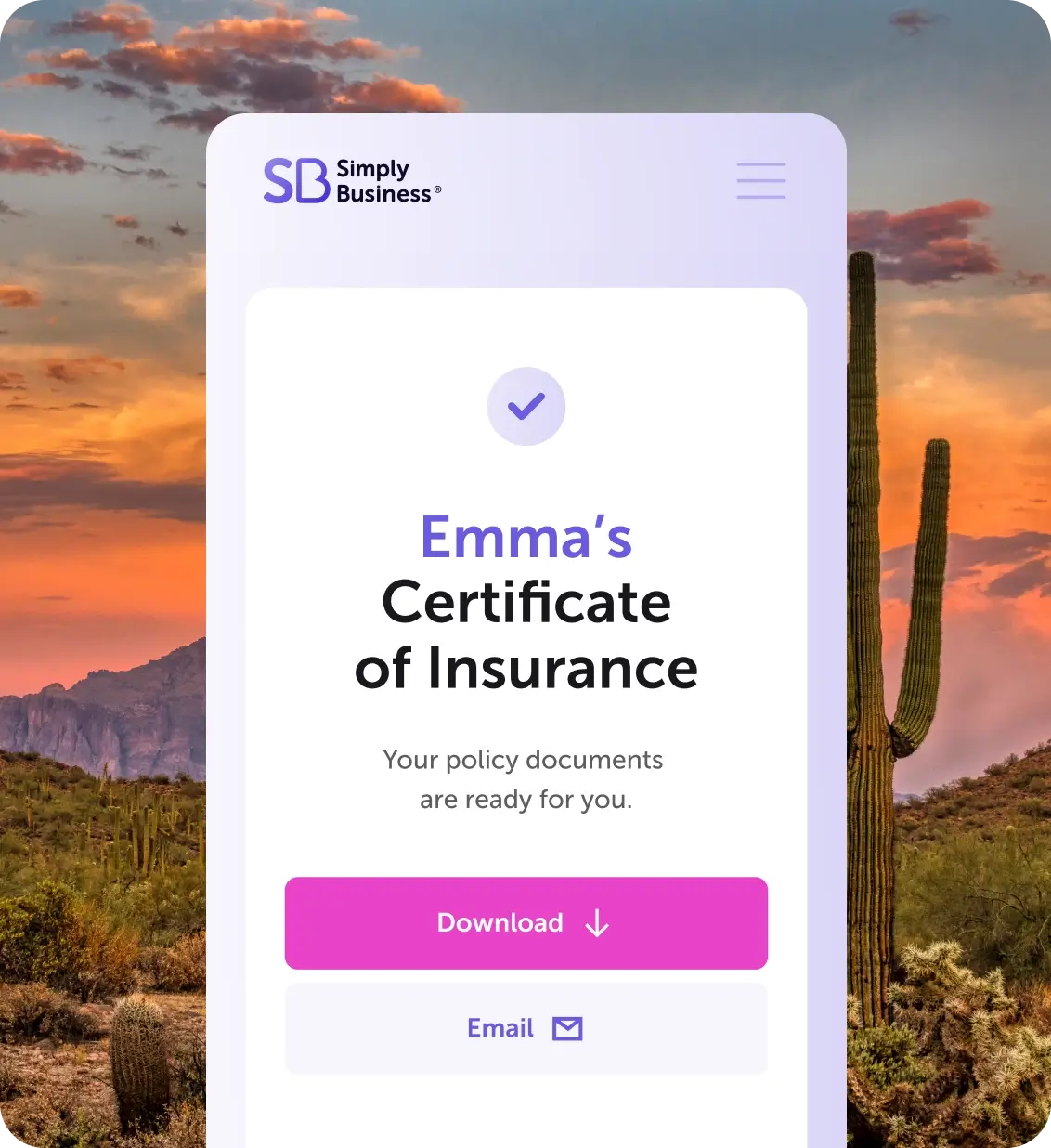
A certificate of insurance (COI) is a document that shows your business has active coverage, along with the policy type(s), limits, and your insurer(s).
With an active Simply Business policy, you can pull your COI from your account, list clients as additional insureds, and download it whenever you need it.
FAQs About Arizona Business Insurance
No. Arizona doesn’t require general liability by law for most businesses, including LLCs. In practice, though, landlords, clients, and general contractors usually want proof of coverage (often $1 million or more) before you can sign a lease, win a contract, or start a job.
Yes. Arizona requires workers’ compensation as soon as you hire even one employee — full-time, part-time, or seasonal — with no small business exemption. The Industrial Commission of Arizona (ICA) enforces the rule under A.R.S. Title 23. Sole proprietors and partners with no employees are exempt, but they can choose to cover themselves.
Significant. The Industrial Commission of Arizona can issue a stop-work order and civil penalties, and an uninsured employer can be held directly liable for an injured worker’s medical benefits. You’d also be at risk of losing the legal protection that typically prevents employees from suing you as a result of a workplace injury, and willful violations can carry criminal exposure.
Yes. To obtain a license from the Arizona Registrar of Contractors (ROC), contractors must post a surety bond, with the amount set by license type and estimated volume of work. Keep in mind that a bond isn’t insurance — it protects your customers, not your business.
Yes, if your business uses vehicles. Personal auto policies exclude business use, so a work-related accident could be denied without a commercial auto policy. Arizona-registered business vehicles must carry liability coverage at the state’s minimum limits.
The Arizona Department of Insurance and Financial Institutions (DIFI) regulates insurers and the insurance market statewide. The Industrial Commission of Arizona oversees workers’ comp, the Arizona Registrar of Contractors (ROC) handles contractor licensing and bonding, and the ADOT Motor Vehicle Division (MVD) covers auto requirements.
Usually, yes. The IRS and the Arizona Department of Revenue generally let businesses deduct insurance premiums as an ordinary and necessary business expense, as long as the coverage is for your trade or business. Check with a tax professional about your specific situation.
All citations to legal and regulatory resources are accurate as of the date this article was/is published.
Our Arizona customers are big fans. And you will be too.
Easy application process. All done online.
John H.
Carpenter
The agent was very helpful and offered what we needed to protect our business.
Pervaiz A.
Restaurant owner
Great rates and a simple buying process.
Stephanie B.
Consulting services
Additional Information and State Resources for Arizona Small Business Owners

Written by

Why Choose Simply Business
Small business insurance is what we do. Whether it’s covering you for accidents and errors, meeting workers’ comp requirements, or financially protecting your business from the unexpected, we can help find the coverage you need for your business.

Start your quote
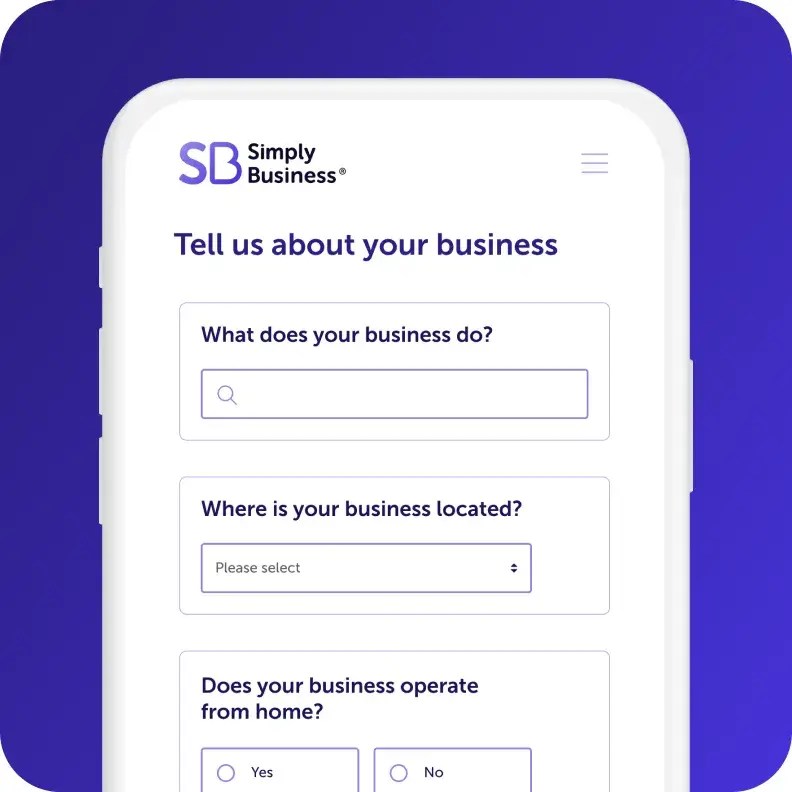
Answer a few questions about
your business in one form.

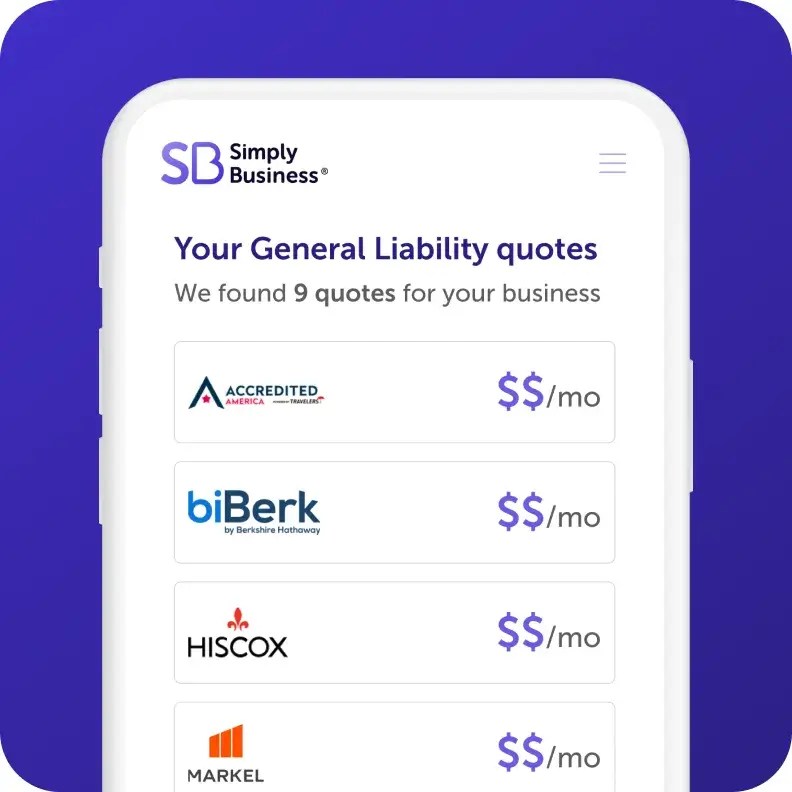
Review quotes
Compare quotes side by side from top-rated insurers and customize your coverage.

Get protected in minutes
Choose your policy, and get instant proof of insurance – all online, and all within 10 minutes.

Feel confident in your choice.
We partner with a range of top-rated carriers and use smart technology to match you with policies that fit your specific business, your risks, and budget.

400+
business types covered

1M+
customers worldwide

18
top-rated carriers


















*The displayed price for each product is a monthly estimate calculated from the 10th percentile of relevant policies sold by Simply Business (e.g., General Liability data is used for General Liability estimates). This estimate uses data from relevant policy sales between July–December 2025. Final price and payment terms, which may include an initial down payment, are subject to change based on your state, selected insurance provider, and specific business details.