Small Business Insurance in Georgia

Get a price estimate in just three steps
Rates as low as $20.75/month*
Get a price estimate in just three steps
Rates as low as $20.75/month*

Over 1 million customers worldwide.


Buy instantly online.

Written by
Georgia Small Business Insurance
Georgia is home to more than 1.4 million small businesses, making up 99.7% of all businesses in the state and employing 1.8 million people across industries ranging from construction and logistics to hospitality and professional services.
Georgia business insurance requirements depend on your industry, the size of your workforce, and how your business operates. Some policies are mandated by state law, while others may be required by the commercial leases and client contracts you sign. Requirements can also vary by county and city, so it’s worth checking local rules in addition to statewide ones.
Getting the right coverage can help protect your business and keep you in compliance with Georgia’s requirements.
On this page
Find the information you need quickly
Is Business Insurance Required in Georgia?
Yes, it is. Georgia mandates workers’ compensation insurance if you regularly employ three or more employees, and auto liability coverage is required for all registered vehicles used and operated in the state, including business vehicles. Specific requirements vary by industry and how your business operates.
General liability and professional liability insurance aren’t required by state law for most businesses, but commercial landlords, clients, and licensing boards frequently require proof of coverage before you can sign a lease, start a project, or obtain a license in Georgia.
What Types of Small Business Insurance Are Required in Georgia?
Georgia small business owners commonly carry a mix of required and recommended coverage. Here’s how the most important policies break down.
Workers’ Compensation Insurance in Georgia
Georgia’s workers’ compensation insurance can help cover medical expenses, lost wages, and rehabilitation costs if an employee is injured or becomes ill on the job. Under Georgia law, any business that regularly employs three or more workers is required to carry coverage.
Full-time, part-time, and seasonal employees all count towards this requirement, as do corporate officers or members of an incorporated business or LLC. Corporate officers count toward your total even if they choose to exempt themselves from coverage. Georgia law generally treats businesses operating as sole proprietorships or partnerships as employers rather than employees when determining whether coverage is required.
Georgia doesn’t have a state workers’ compensation fund, so businesses must purchase coverage through a private insurer.
Professional Liability Insurance (E&O) in Georgia
Professional liability insurance, also known as errors and omissions (E&O), can help cover claims of negligence, mistakes, or oversights in the work you deliver, including legal defense costs, even if a claim turns out to be without merit.
Georgia doesn’t require E&O as a general state law, but certain licensed professionals may be required to carry it through their governing boards. For example, real estate commissions, accountancy boards, medical boards, and state legal bar organizations may have requirements for professional liability or malpractice insurance in their own rules.
Georgia doesn’t require many types of business insurance, so having coverage can provide another layer of protection.
General Liability Insurance in Georgia
General liability insurance helps protect your business against third-party claims, including bodily injury, property damage, and reputational harm. While there is no state law or regulation that requires every business to carry GL coverage, many commercial landlords and clients won’t let you sign a lease or begin work without proof of coverage.
However, some industries have their own requirements. General contractors in Georgia, for example, must carry at least $500,000 in general liability coverage to obtain a license.
Commercial Auto Insurance in Georgia
If your business owns or operates vehicles, a personal auto policy typically won’t cover accidents that happen during business use. Georgia’s financial responsibility law requires liability insurance on all vehicles, including those used for business purposes. The minimum limits are $25,000 for bodily injury per person, $50,000 per accident, and $25,000 for property damage.
Your personal auto insurance may not cover you if you get into an accident while driving to a job site or during business use. So, in Georgia, commercial auto coverage may be something to consider.
Simply Business doesn’t currently offer commercial auto insurance, but our licensed insurance agents can refer you to providers that do.
Get free Georgia business insurance quotes in 10 minutes or less.
Simply Business provides customized coverage options from top-rated small business insurers — all in just 10 minutes. We do all the leg work so you can sit back, compare quotes, and save.
How Much Does Business Insurance Cost in Georgia?
Here are average monthly ranges1 for common policies based on purchases by Simply Business customers in Georgia:
Median Monthly Costs1
| General liability | $42 |
| Professional liability: | $38 |
| Workers’ compensation: | $59 |
| Business owner’s policy | $123 |
1Data from Simply Business customers located in Georgia, who purchased at least one or a combination of BOP, general liability, professional liability, and workers’ compensation policies from July 1, 2025 to December 31, 2025. The median costs shown are for illustrative purposes only; actual premiums vary by state, coverage limits, and individual business risk.
The cost of business insurance in Georgia depends on several factors, and what you pay can vary significantly from one business to the next.
Some factors that affect your premium include, but are not limited to:
- Payroll: Businesses with more employees and a higher total payroll typically pay more for workers’ compensation coverage in Georgia.
- Industry risk: A roofing contractor may carry a different risk profile than a marketing consultant, and premiums reflect that difference.
- Location: Operating in the Atlanta metro area can affect your premium compared to a smaller market like Macon or Augusta.
- Claims history: A prior claims record can push your rate higher at renewal.

Who Needs Georgia Small Business Insurance?
State-Specific Risks and Rules for Businesses in Georgia
Georgia small businesses face risks shaped by the state’s weather patterns, data laws, and employment landscape.

Severe Weather
Georgia’s weather-related disaster history includes hurricanes, tornadoes, severe storms, wildfires, and flooding. Central and north Georgia have seen tornado outbreaks, while coastal and southern areas face hurricane-force winds and storm surges, but storm damage can reach well beyond the coast. Commercial property and business interruption coverage can help protect against losses when operations are forced to shut down.

Data Breach Notification
Under Georgia law, businesses that experience a breach involving personal information must notify affected residents as quickly as possible and without unreasonable delay. If the breach impacts more than 10,000 residents of the state, the business must also notify nationwide consumer reporting agencies. Cyber liability insurance in Georgia can help cover notification costs, legal fees, and recovery expenses.

Restrictive Covenants
Georgia’s Restrictive Covenants Act permits non-compete and non-solicitation agreements that are reasonable in time, territory, and scope, and allows courts to modify provisions that are too broad instead of voiding the agreement entirely. For businesses with sales, technical, or executive staff, employee departures can potentially lead to lawsuits. Employment Practices Liability Insurance (EPLI) can help cover legal costs if a dispute goes to court. Please note that Simply Business does not currently offer EPLI.
Best Georgia Business Insurance for Your Industry
Insurance needs vary by industry. Here’s what Georgia small businesses in common sectors may want to consider.
Construction Insurance in Georgia
Construction contractors often work on physical job sites with large crews and heavy equipment, and their work can affect third-party property. General liability insurance is required for general contractors in Georgia, and workers’ compensation is mandatory once you hit the employee threshold required by law.
Retail and Restaurant Insurance in Georgia
Retail stores and restaurants deal with steady foot traffic, physical inventory, and the day-to-day exposure that comes with serving the public. A business owner’s policy (BOP) in Georgia combines general liability and commercial property coverage in a single policy, helping to protect your space, inventory, and liability.
If your business serves alcohol, standard commercial general liability policies typically exclude liquor liability for businesses that sell or serve alcohol. Liquor liability coverage may be included in your policy depending on your carrier, whether you hold an active Georgia alcohol license, and the state where you operate.
Tech and Professional Services Insurance in Georgia
Atlanta is home to many tech and fintech companies, and the businesses like these often carry risks that general liability alone doesn’t cover. Professional liability insurance helps protect against claims that your work caused a client financial harm, something that matters whether you’re a software developer, consultant, or accountant. Many enterprise contracts may require E&O as a condition of doing business.
Cyber liability insurance helps businesses handling client data, financial records, or proprietary information. Coverage can help with the breach response costs and legal exposure following a security incident, which is a real risk in industries where personal data is important.
How to get a Certificate of Insurance in Georgia
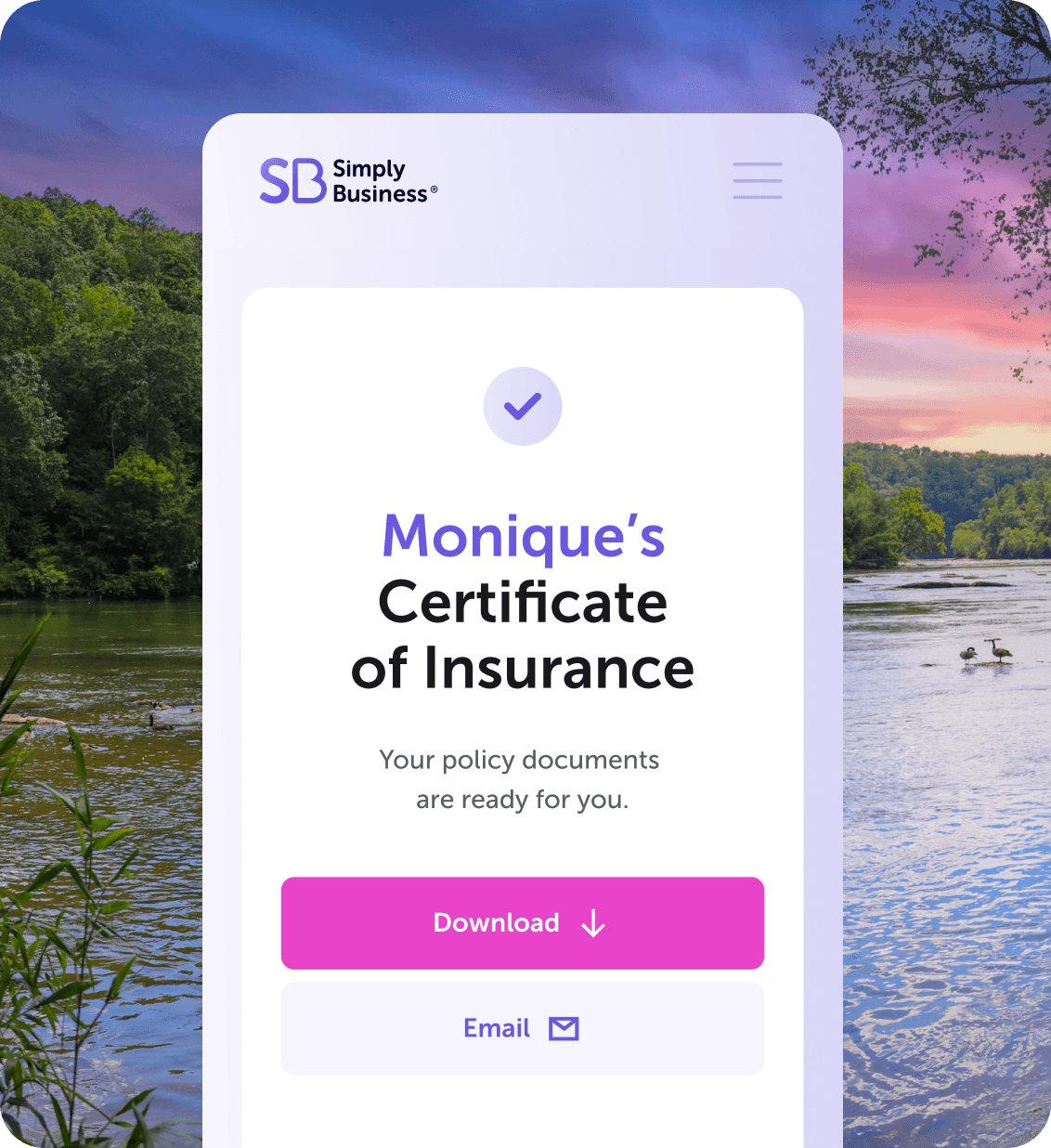
A certificate of insurance (COI) is a document that proves your business has active coverage. It lists your policy details, coverage limits, and insurer. Many landlords, clients, and licensing boards typically ask for it before beginning work or signing an agreement. If a client or project requires you to name them as an additional insured on your policy, contact your insurer to update your policy.
If you have a policy through Simply Business, you can download your COI directly from your account. For most policies, there’s no waiting period. Once your policy is active, the certificate is available immediately.
FAQs about Georgia Business Insurance
Do I need workers’ compensation insurance if I only have two employees?
Georgia requires workers’ comp coverage once a business regularly employs three or more workers, including full-time, part-time, and seasonal employees. With two employees, you’re below the threshold, but if you’re considering hiring a third, you may want to get coverage in place before you do so.
Is general liability insurance required for an LLC in Georgia?
Forming an LLC in Georgia doesn’t require you to carry general liability insurance. But an LLC doesn’t protect your business from every type of liability, and most commercial landlords, clients, and licensing boards will require proof of coverage before you can rent space, start a project, or get a license. Your business’s structure doesn’t change those contract requirements.
Who regulates business insurance in Georgia?
Business insurance in Georgia is regulated by the Georgia Office of the Commissioner of Insurance and Safety Fire. This office licenses insurers operating in the state, handles consumer complaints, and enforces insurance laws. If you have a dispute with your insurer or want to verify a company’s licensing status, the OCI can help.
Additional Information and State Resources for Georgia Small Business Owners
Georgia Department of Revenue: Vehicle insurance requirements
Georgia Office of Commissioner of Insurance: Business insurance requirements
State Board of Workers’ Compensation
Business licensing division of Georgia
Qualifications for a general contractors license in Georgia
Our +1 million customers are big fans. And you will be too.

I went online, looked around, and found Simply Business. The process was so seamless. I got my certificate within minutes. It was just phenomenal.

Karen
Owner of Tangaza Bath & Body Studio LLC
With Simply Business I know I can look at different carriers, but also see all my stuff in the same place… a lot of [insurance] providers don’t offer a variety of coverage, all in one place.

Jef
Owner of Bunker83 LLC
It wasn’t overwhelming to figure out what was covered and what wasn’t covered. And the cost was competitive.

Kim
Owner of Room to Breathe Professional Organizing
Written by